Why Difference Feels Dangerous When Relational Capacity is Low

Many leadership teams pride themselves on their diversity initiatives. They invest in training, update their policies, create affinity groups. On paper, they look good.
So why is it that in the room, something else is happening?
Every time a conversation touches on difference – whether it is race, gender, working style or conflicting priorities – the air changes. Bodies stiffen. Speech slows. The politeness becomes so thick you can almost taste it. People who normally speak freely suddenly edit themselves mid-sentence. Others jump in too quickly, rushing to smooth things before tension builds.
Senior leaders regularly say to me “We keep talking about psychological safety. But the more diverse we become, the less safe it feels to actually be honest.”
They are not wrong. There are not describing a failure of values or commitment to inclusion. They are describing what happens when relational capacity cannot hold the nervous system load that difference creates.
Diversity Increases Nervous System Load when Relational Capacity Is Low
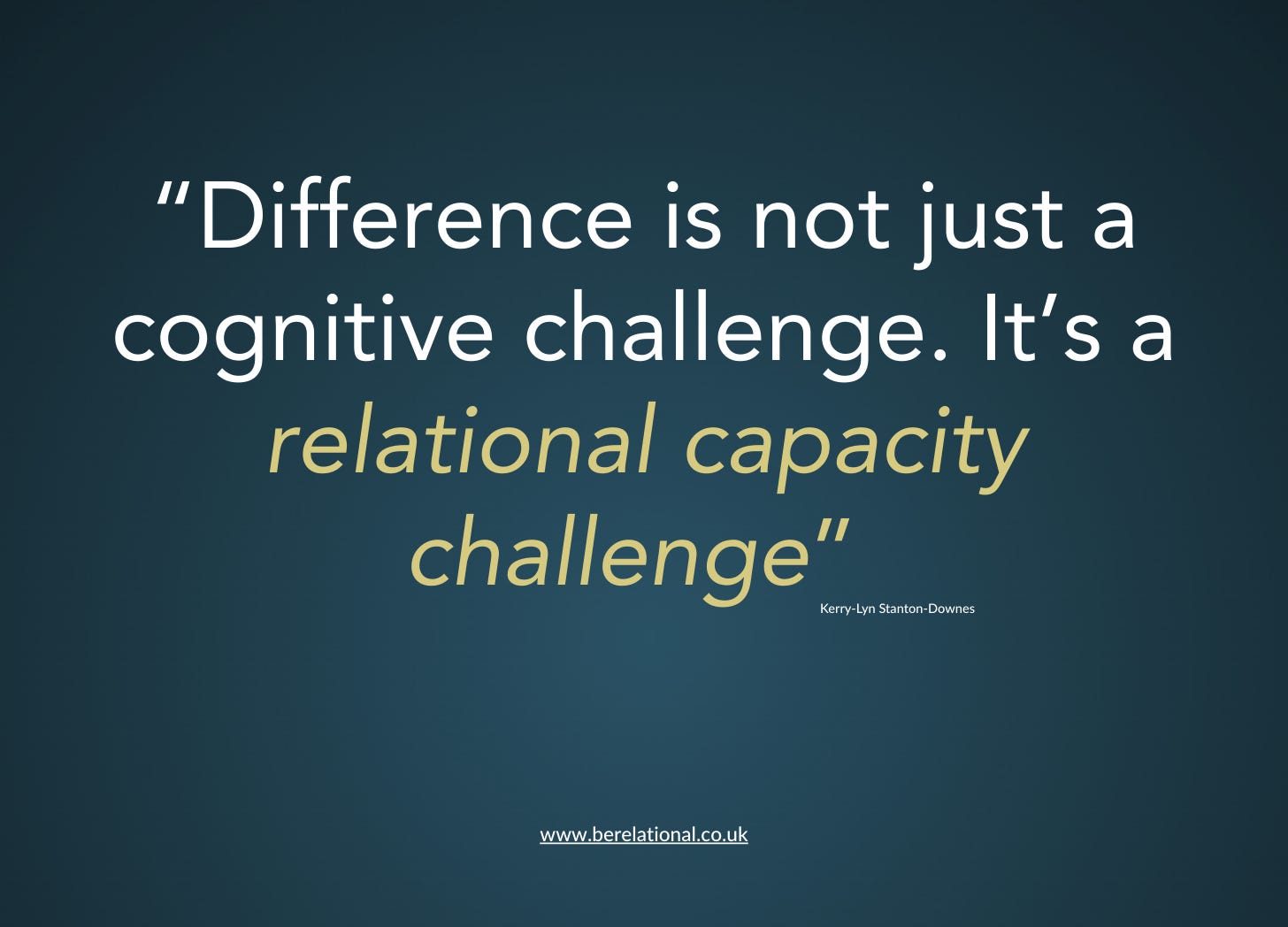
I believe what most inclusion frameworks miss is the fact difference is not just a cognitive challenge. It is a relational capacity challenge.
When you work alongside people whose experiences, perspectives, communication style, or social identities differ significantly from your own, your nervous system is processing more complexity. You are reading social cues you’re less familiar with. Navigating norms that may not be shared. Holding uncertainty about whether you’ll be understood or whether you’ll misunderstand. Wondering if the way you show up will cause harm or be misread.
Your nervous system is designed to detect patterns and predict safety based on what’s familiar. Stephen Porges’ Polyvagal Theory shows us that the nervous system is constantly assessing: Is it safe here? Can I relax my vigilance? Or do I need to stay alert? When the patterns are unfamiliar – when you cannot rely on shared context or predictable responses – the nervous system stays more activated. Not because something is wrong, because more processing is required – and that requires energy, time and effort.
So this is not a problem to be solved. This is the reality of working across difference.
The problem emerges when we try to navigate this complexity without the relational capacity to hold it. When the space between people lacks the safety, trust, self regulation and co-regulation needed to stay present with uncertainty, then difference starts to feel like threat.
And when difference feels like threat, we protect ourselves. We retreat into performance. We self-censor. We default to the safest version of ourselves. We stop risking being fully seen.
The result? Organisations that look diverse but feel homogeneous. Teams where people show up, but never full arrive.
What Relational Capacity Actually Is
Relational capacity is not warmth. It is not likability. It is not even trust in the conventional sense.
Relational capacity is the ability of a relational space to hold complexity, tension and uncertainty without collapsing into defensiveness, politeness, or disconnection.
It is what allows people to stay present when they do not immediately understand each other. To be curious when they feel threatened. To name what is happening without making it mean something catastrophic about the relationship.
Relational capacity is built through micro-moments of co-regulation: the moments when someone stays open when you are uncertain. When disagreement does not equal rupture. When your nervous system learns, through repeated experience, that difference is not inherently dangerous here.
This capacity is not evenly distributed. As this is where the conversation about inclusion gets really important.
Why Everyone Is Doing More Nervous System Work Than They Realise
When we fail to build relational capacity our nervous systems are working hard. Not just in some people. In everyone.
Your nervous system is constantly asking: Am I safe? Am I Accepted? Will I be understood? Can I be myself? And it’s answering these questions by marrying your current experience with your history, your memories, every past interaction where you felt seen or dismissed, included or othered.
These is not always conscious. It is your nervous system doing what it is designed to do: predict threat based on pattern.
The challenge is we are all bringing different pattern libraries to the same space. Different histories. Different experiences of when it has been safe to speak and when it has not. Different thresholds for what registers as threat.
So, when a team gathers, everyone is navigating their own version of: How much of myself can I bring here? What’s the cost of being honest? What happens if I get this wrong?
It get’s even more complex because the type of nervous system ‘work’ people are doing varies dramatically depending on their experiences.
Some people are primarily navigating: Will my competence be questioned? Will my ideas be taken seriously? Will I be seen as belonging here?
These questions arise from repeated experiences where aspects of their identity – whether race, gender accent, age, neurodivergence, or any other difference – have been met with doubt, dismissal, or the need to prove themselves again and again. There nervous system has learned: Being myself here comes at a cost.
The pattern they are scanning for: Is this one of those spaces?
Other people are primarily navigating: Will I say the wrong thing? Will I cause harm without meaning to? Will I be seen as ignorant or insensitive?
These questions arise from awareness that their own frame of reference may not account for others’ experiences. They’re trying to be respectful, and they’re uncertain about the rules. Their nervous system has learned: I don’t always know what I am doing and what I don’t know.
The pattern they are scanning for: How do I stay engaged without getting it wrong?
Still others are navigating: Is it safe to challenge? Can I disagree without rupturing relationship? Will complexity be tolerated here?
These questions arise from past experiences where directness was punished, or where disagreement meant disconnection. Their nervous system has learned: Honesty is risky.
The pattern they are scanning for: Can this space hold the tension of different thinking?
These are not competing experiences. They are all happening simultaneously, in the same room, in the same moment. And they’re all rooted in the same neurobiological process: your nervous system using past experience to predict present safety.
The problem is not that people are doing this nervous system work. The problem is that we are trying to do it in relational spaces that lack the capacity to hold all of it at once.
What Happens When No One Feels Safe to Be Themselves
When relational capacity is low, everyone starts performing a version of themselves that feels safer than the real thing.
The person who’s wondering Will my competence be questioned? Starts pre-emptively proving their worth. The over-prepare. They stay quiet in meetings unless they are certain their contribution will land well. They edit themselves constantly.
The person who’s wondering: Will I cause harm? Becomes so cautious they stop engaging authentically. They retreat into politeness. They avoid difficult conversations. They stay surface-level because depth feels too risky.
The person who’s wondering: Can I disagree here? stops challenging. They go along. They keep their concerns private. They become conflict-avoidant not because they lack courage, because past experience taught them speaking up has relational cost.
What most organisations miss is that these are not individual problems to be solved through better self-regulation. These are relational conditions creating survival responses.
When people fear they won’t be accepted, their nervous system shifts into a state of hypervigilance or withdrawal. Not because they are fragile. Because they are adaptive. Because their nervous system is protecting them based on what it has learned is necessary here.
The cost is enormous. Energy that could go toward creativity, collaboration, and innovation is instead diverted to managing threat that may or may not be real. And because everyone is doing their own version of this calculation, the relational space becomes thinner and thinner.
People stop taking risks. They stop being honest. They stop bringing their full and most brilliant selves. And diversity – which is meant to make teams stronger – instead becomes a source of strain that no one knows how to name.

Inclusion Is a Co-Regulatory Practice
So what does it actually take to hold difference well?
It takes relational capacity. And building relational capacity requires co-regulation.
Co-regulation is the process by which nervous systems help each other stay present, even when things feel uncertain or uncomfortable. It is what happens when someone meets your survival state with curiosity rather than defensiveness. When you can name tension without relationship fracturing. When disagreement is help as information rather than as rupture.
This is not soft. This is deeply practical. Because when relational capacity is high enough to hold difference, something shifts.
People stop performing their inclusion and start actually connecting.
Differences stop being things to be managed and become sources of insight.
Leaders stop retreating into sameness because complexity no longer feels like threat.
Co-regulation cannot be mandated. It cannot be installed through policy or training. It has to be practices, in real time, repeatedly, in the micro-moments of interaction. It requires leaders who are willing to notice when their own nervous system is activated and stay present anyway. It requires teams who can name what is happening in the relational space without making it about individual failure.
It requires us to stop treating inclusion as a set of behaviours and start treating it as a relational condition.
What This Means for Organisations
If you are serious about inclusion, you have to get serious about building relational capacity.
This means:
Noticing when politeness is masking withdrawal: Politeness is not the same as safety. It is often a sign that people have decided honesty is too risky.
Building spaces where people can name tension without it being catastrophic: When tension cannot be named, it accumulates. And accumulated tension erodes relational capacity faster than almost anything else.
Investing in co-regulation as infrastructure, not as an individual skill: This is not about teaching people to be more resilient. This is about creating conditions where nervous systems can stay present together.
Understanding inclusion is not a destination: It is a continuous practice of staying present across difference, even when it is hard. Especially when it is hard.
The Invitation
Difference does not have to feel dangerous.
It will continue to feel dangerous until we build the relational capacity to hold it.
This is not about lowering standards or making everything comfortable. This is about creating the conditions where people can actually show up fully – with all of their complexity, uncertainty, and difference – and know the relational space is strong enough to hold them.
When relational capacity is high, difference becomes generative. It becomes the thing that makes teams smarter, more adaptive, more human.
When relational capacity is low, difference becomes the thing people try to minimise, manage, or avoid.
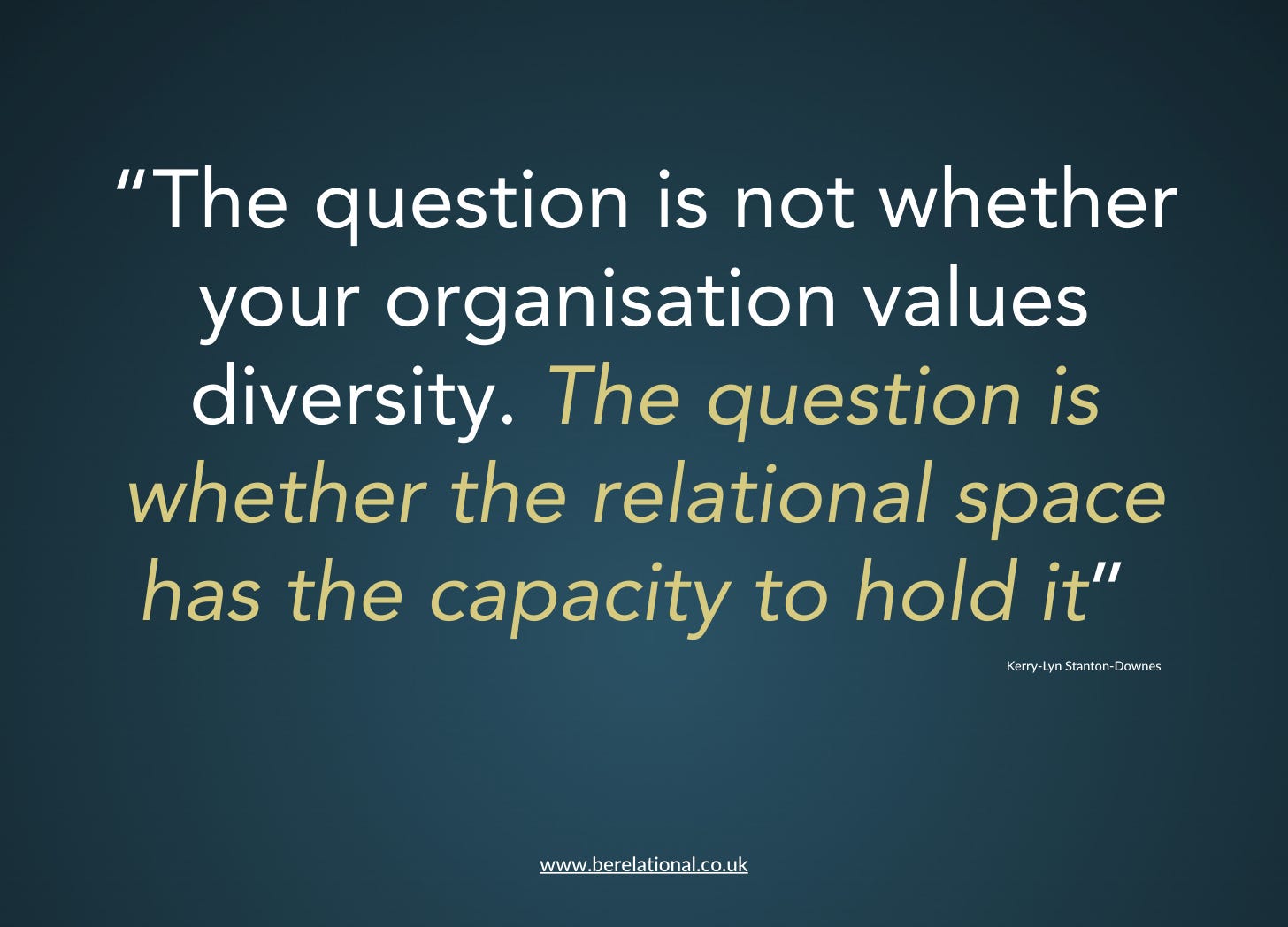
The question is not whether your organisation values diversity – the question is whether your relational space has the capacity to hold it.